
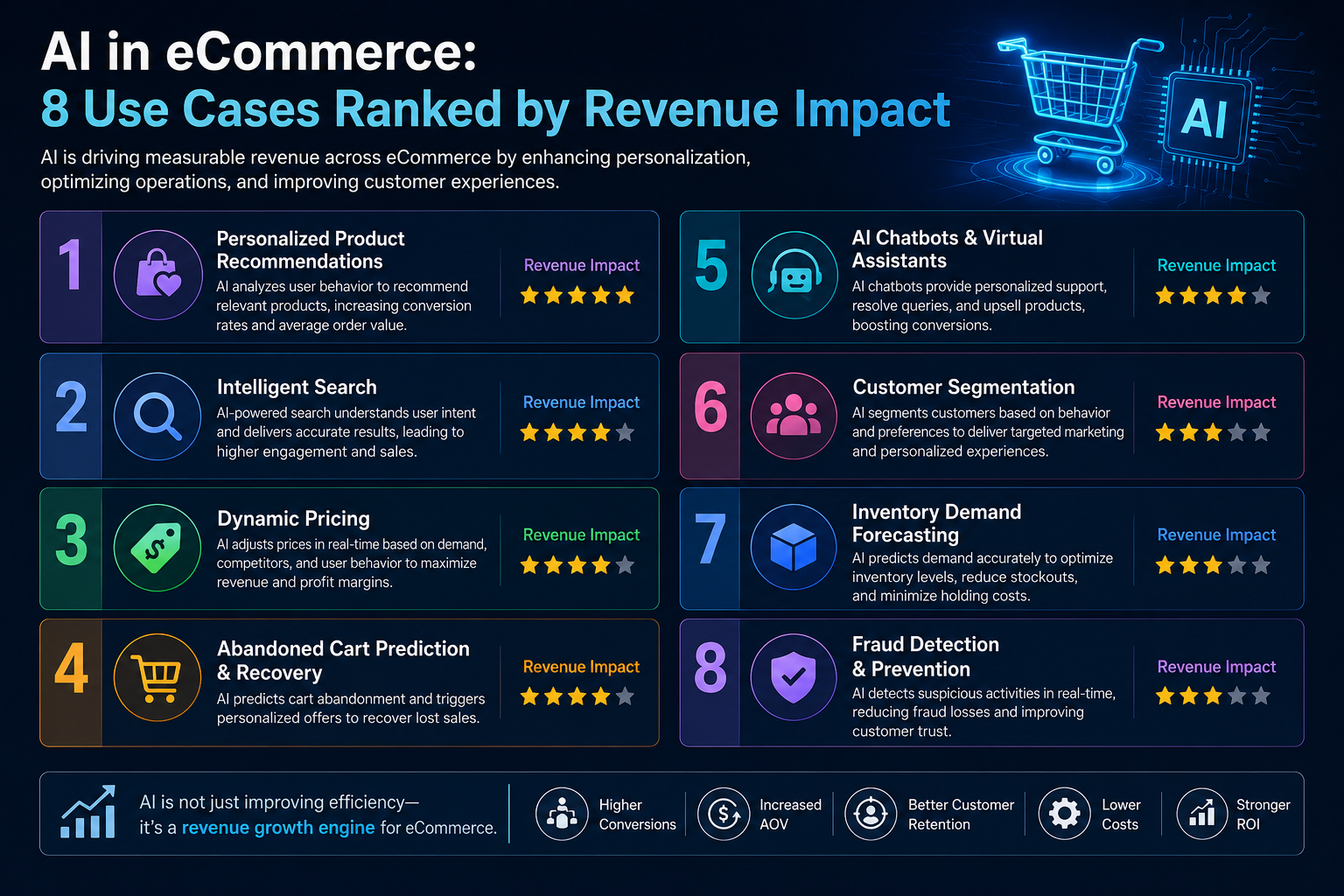
What Are the Highest Revenue Impact AI Use Cases in eCommerce?
AI in eCommerce creates the biggest revenue impact through personalized product recommendations,
AI-powered marketing automation, customer service assistants, demand forecasting, dynamic pricing,
and AI-generated content workflows that improve conversions and customer retention.
Why AI Is Becoming Essential for eCommerce Growth
The ecommerce industry is entering a new era where artificial intelligence is no longer just
an experimental technology. Brands are using AI to understand customers, automate operations,
create better shopping experiences, and increase revenue.
From AI-generated product visuals to intelligent recommendation systems, businesses are
building automated commerce ecosystems that improve every stage of the customer journey.
8 AI in eCommerce Use Cases Ranked by Revenue Impact
1. AI Personalization & Product Recommendations
AI-powered recommendation engines analyze customer behavior, browsing history, and purchase
patterns to suggest relevant products. This creates personalized shopping experiences that
increase conversion rates and average order value.
- Personalized product suggestions
- AI shopping assistants
- Customer behavior analysis
- Higher repeat purchases
2. AI Marketing Automation
AI helps ecommerce brands automate email campaigns, advertising optimization, customer
segmentation, and personalized marketing messages.
- Automated email personalization
- AI-powered ad optimization
- Customer journey automation
- Predictive marketing insights
3. AI Content Creation for Ecommerce
Generative AI tools allow brands to create product descriptions, advertising creatives,
social media content, and visual assets faster while maintaining brand consistency.
- AI product descriptions
- Automated social media content
- AI-generated product images
- Creative workflow automation
4. AI Customer Service Chatbots
AI chatbots provide instant customer support, answer product questions, and improve shopping
experiences without requiring constant human intervention.
- 24/7 customer assistance
- Automated FAQs
- Order tracking support
- Faster response times
5. AI Demand Forecasting & Inventory Management
AI analyzes sales trends, customer demand, and market behavior to help businesses predict
inventory needs and reduce operational costs.
- Smarter inventory planning
- Reduced product waste
- Improved supply chain decisions
6. Dynamic Pricing Optimization
AI pricing systems analyze market conditions, competitors, and customer behavior to adjust
prices strategically and maximize profitability.
7. AI Visual Search & Shopping Experiences
Visual AI allows shoppers to search using images instead of keywords, creating faster and
more intuitive shopping journeys.
- Image-based product discovery
- Smart product matching
- Improved customer engagement
8. AI Analytics & Revenue Prediction
AI analytics platforms help ecommerce brands understand customer behavior, predict sales
opportunities, and make smarter business decisions.
“AI is transforming ecommerce from simple online selling into intelligent, personalized,
and automated shopping ecosystems.”
The Future of AI in eCommerce
The next generation of ecommerce will combine AI shopping assistants, automated creative
production, predictive analytics, and personalized customer experiences.
Businesses that adopt AI workflows early will gain advantages in customer engagement,
marketing efficiency, and revenue growth.
Conclusion
AI in eCommerce: 8 Use Cases Ranked by Revenue Impact shows how artificial intelligence is
becoming a core growth engine for modern online businesses.
From personalization and automation to AI content creation and predictive analytics,
companies can use AI to build smarter ecommerce systems and create better customer
experiences.


