
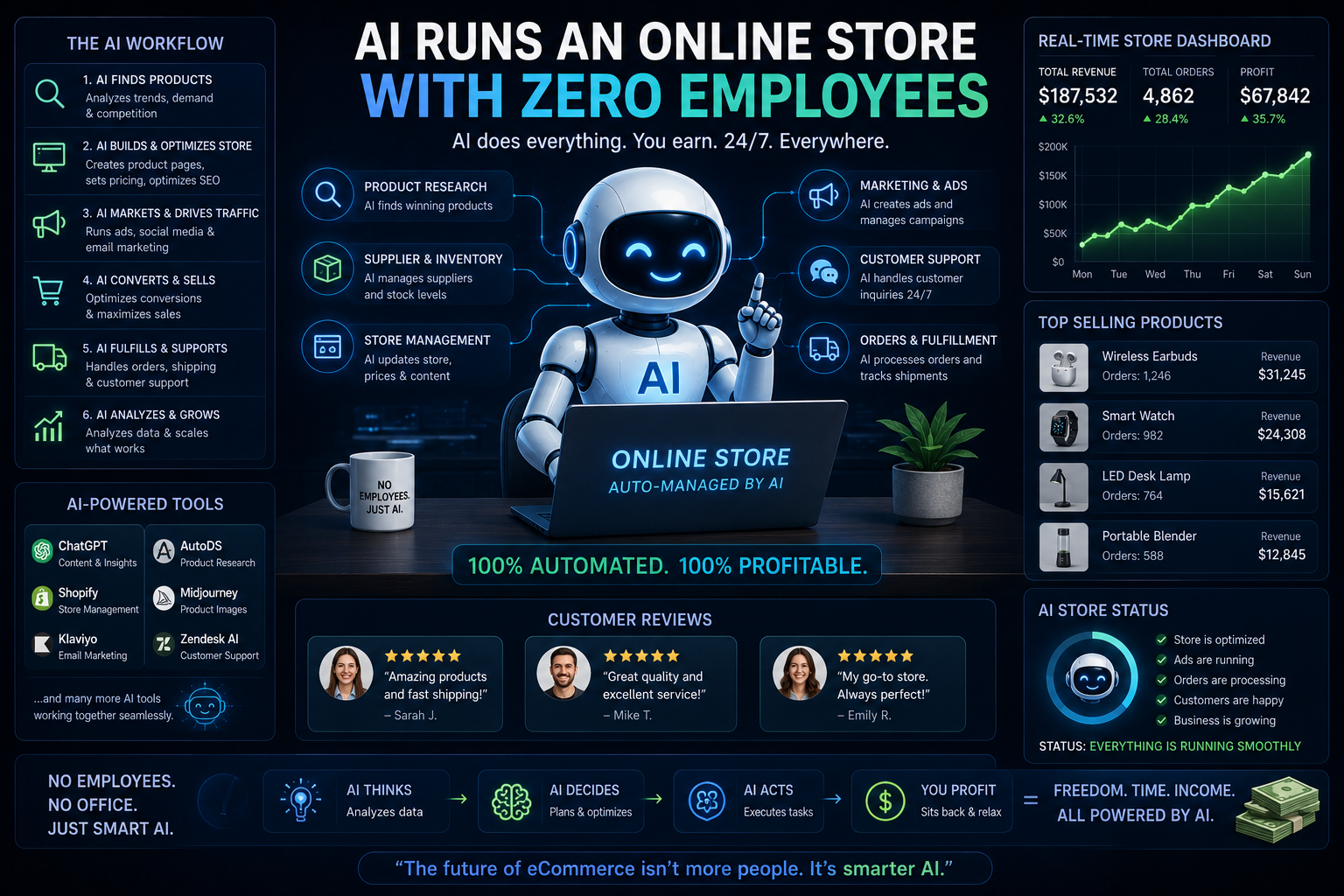
Can AI Run an Online Store with Zero Employees?
Yes. Modern AI systems can automate product research, inventory forecasting, customer service, content creation, advertising, and sales optimization. While human oversight remains valuable, many ecommerce operations can now function with minimal or even zero full-time employees.
The Rise of Fully Automated Ecommerce
The concept of an online business running without employees once sounded impossible. Today, AI-powered platforms are making it increasingly realistic.
Advanced automation tools can handle repetitive tasks that traditionally required entire teams. As AI technology improves, digital businesses can scale faster while reducing operational costs.
- Automated product sourcing
- AI-generated product descriptions
- 24/7 customer support chatbots
- Smart inventory management
- Automated email marketing
- Predictive sales forecasting
How AI Handles Daily Store Operations
Running an online store involves hundreds of daily decisions. AI systems can process large amounts of data and execute tasks automatically.
Product Research and Selection
AI tools analyze market trends, social media conversations, search demand, and competitor data to identify potentially profitable products.
Instead of spending days researching trends manually, businesses can generate product opportunities within minutes.
Content Creation
AI writing systems can generate:
- Product descriptions
- SEO content
- Email campaigns
- Social media posts
- Advertising copy
This dramatically reduces content production costs while maintaining consistency across platforms.
Customer Support Automation
AI chatbots can answer customer questions instantly, process returns, provide shipping updates, and recommend products based on user behavior.
Many customers now interact with AI support systems without realizing they are communicating with automation.
AI Marketing Systems Drive Growth
Marketing is often one of the most expensive parts of ecommerce operations. AI is transforming how brands acquire and retain customers.
- Audience targeting
- Ad optimization
- Campaign automation
- Email personalization
- Customer segmentation
- Conversion rate optimization
AI can continuously analyze campaign performance and make adjustments faster than traditional marketing teams.
The Role of AI in the Creator Economy
The creator economy is becoming increasingly dependent on automation.
AI-generated videos, product photography, influencer content, and social media campaigns allow creators to build digital brands without hiring large teams.
This shift is lowering barriers to entry for entrepreneurs and enabling faster business launches.
Benefits of a Zero-Employee Online Store
- Lower operating costs
- Faster business scaling
- 24/7 availability
- Consistent customer experiences
- Data-driven decision making
- Reduced administrative workload
For startups and solo entrepreneurs, these advantages can create significant competitive opportunities.
Challenges and Limitations
Despite rapid progress, AI still faces limitations.
- Complex customer issues
- Brand strategy decisions
- Creative direction oversight
- Unexpected market shifts
- Ethical and compliance concerns
Businesses that combine automation with strategic human oversight often achieve the best long-term results.
The Future of AI-Powered Commerce
As machine learning models become more sophisticated, fully automated ecommerce operations will likely become increasingly common.
Future stores may rely on interconnected AI systems that manage everything from supply chains to customer relationships without requiring traditional employee structures.
Businesses that understand these technologies today may gain a significant advantage as automation becomes a standard part of digital commerce.
Conclusion
The idea that AI runs an online store with zero employees is no longer science fiction. Automation technologies are rapidly transforming ecommerce, marketing, content creation, and customer support.
While human expertise remains important for strategy and innovation, AI-powered workflows are reshaping how online businesses operate and scale. The future of ecommerce will likely belong to organizations that successfully combine intelligent automation with smart business leadership.


