
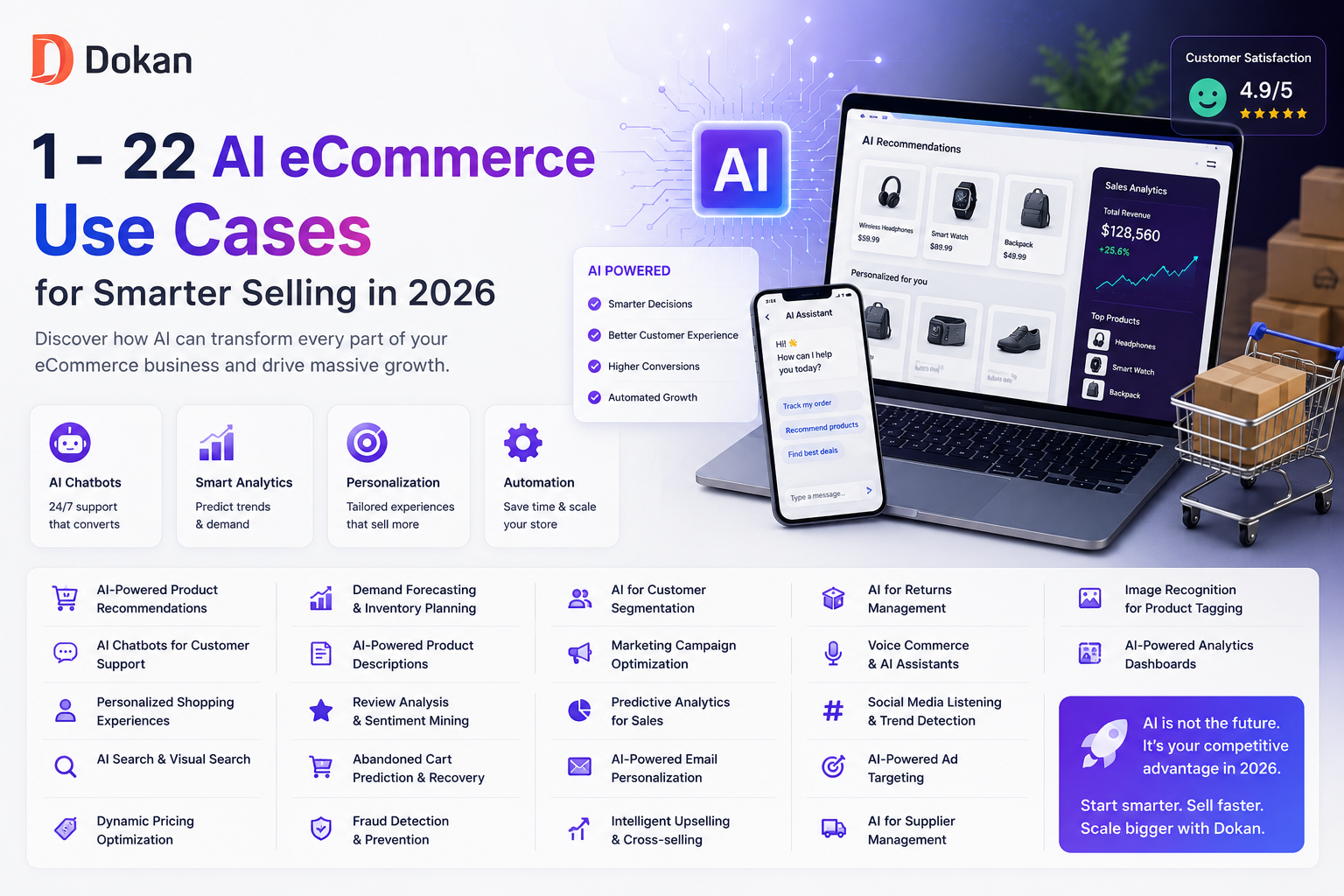
What Are AI eCommerce Use Cases?
AI eCommerce use cases are practical applications of artificial intelligence that help online businesses automate repetitive tasks, improve customer experiences, personalize shopping journeys, optimize pricing, forecast demand, and increase sales. In 2026, AI has become a core technology powering smarter and more profitable eCommerce operations.
Why AI Is Essential for eCommerce in 2026
The rapid evolution of AI has changed how consumers discover, compare, and purchase products online. Modern shoppers expect personalized experiences, instant customer support, and accurate product recommendations.
Businesses that integrate AI into their online stores gain advantages such as:
- Higher conversion rates
- Lower operational costs
- Faster customer support
- Improved inventory planning
- Smarter marketing campaigns
- Better customer retention
22 AI eCommerce Use Cases Driving Smarter Selling
1. Personalized Product Recommendations
AI analyzes browsing behavior and purchase history to recommend products customers are most likely to buy.
2. AI Chatbots
Virtual assistants provide instant answers, process orders, and resolve customer issues 24/7.
3. Smart Product Search
AI understands natural language searches, helping shoppers find products faster.
4. Dynamic Pricing
Pricing automatically adjusts based on competitors, inventory, and customer demand.
5. Inventory Forecasting
Predictive analytics estimate future sales and reduce stock shortages.
6. Customer Segmentation
AI groups shoppers based on behavior for highly targeted campaigns.
7. Email Personalization
Every email becomes customized using customer interests and buying patterns.
8. Fraud Detection
Machine learning identifies suspicious transactions before payment is completed.
9. Visual Search
Customers upload photos to instantly locate similar products.
10. Voice Commerce
AI supports shopping through voice assistants and smart devices.
11. AI Content Generation
Automatically generate product descriptions, blogs, and promotional copy.
12. Automated Customer Support
Support tickets are categorized and answered using AI-powered workflows.
13. Predictive Analytics
AI predicts future purchasing trends to improve decision-making.
14. Review Analysis
Sentiment analysis uncovers customer satisfaction and product issues.
15. Personalized Landing Pages
Visitors see customized offers based on browsing behavior.
16. Upselling & Cross-selling
AI suggests complementary products that increase average order value.
17. Marketing Automation
Campaigns automatically optimize budgets, audiences, and creatives.
18. AI Image Enhancement
Improve product photos using AI editing and background removal.
19. Demand Forecasting
Predict seasonal demand and prepare inventory ahead of peak shopping periods.
20. Supply Chain Optimization
AI improves logistics, warehouse planning, and delivery efficiency.
21. Customer Lifetime Value Prediction
Identify high-value customers and improve retention strategies.
22. Sales Performance Analytics
AI dashboards provide real-time insights into revenue, customer behavior, and marketing ROI.
“Businesses using AI aren’t replacing people—they’re empowering teams to make faster decisions, create better shopping experiences, and scale more efficiently.”
Benefits of AI for Online Stores
- Increase online sales
- Reduce manual work
- Deliver personalized shopping experiences
- Improve customer satisfaction
- Automate marketing workflows
- Optimize inventory management
- Boost operational efficiency
- Improve conversion rates
Future of AI in eCommerce
As AI technology advances throughout 2026, online retailers will increasingly rely on predictive intelligence, autonomous marketing systems, generative AI content, and real-time personalization. Businesses that embrace these innovations today will be better positioned to compete in tomorrow’s digital marketplace.
Conclusion
AI eCommerce use cases are transforming every aspect of online selling—from customer service and product discovery to inventory management and marketing automation. By adopting these AI-powered solutions, businesses can build smarter, faster, and more profitable eCommerce operations in 2026 and beyond.


