
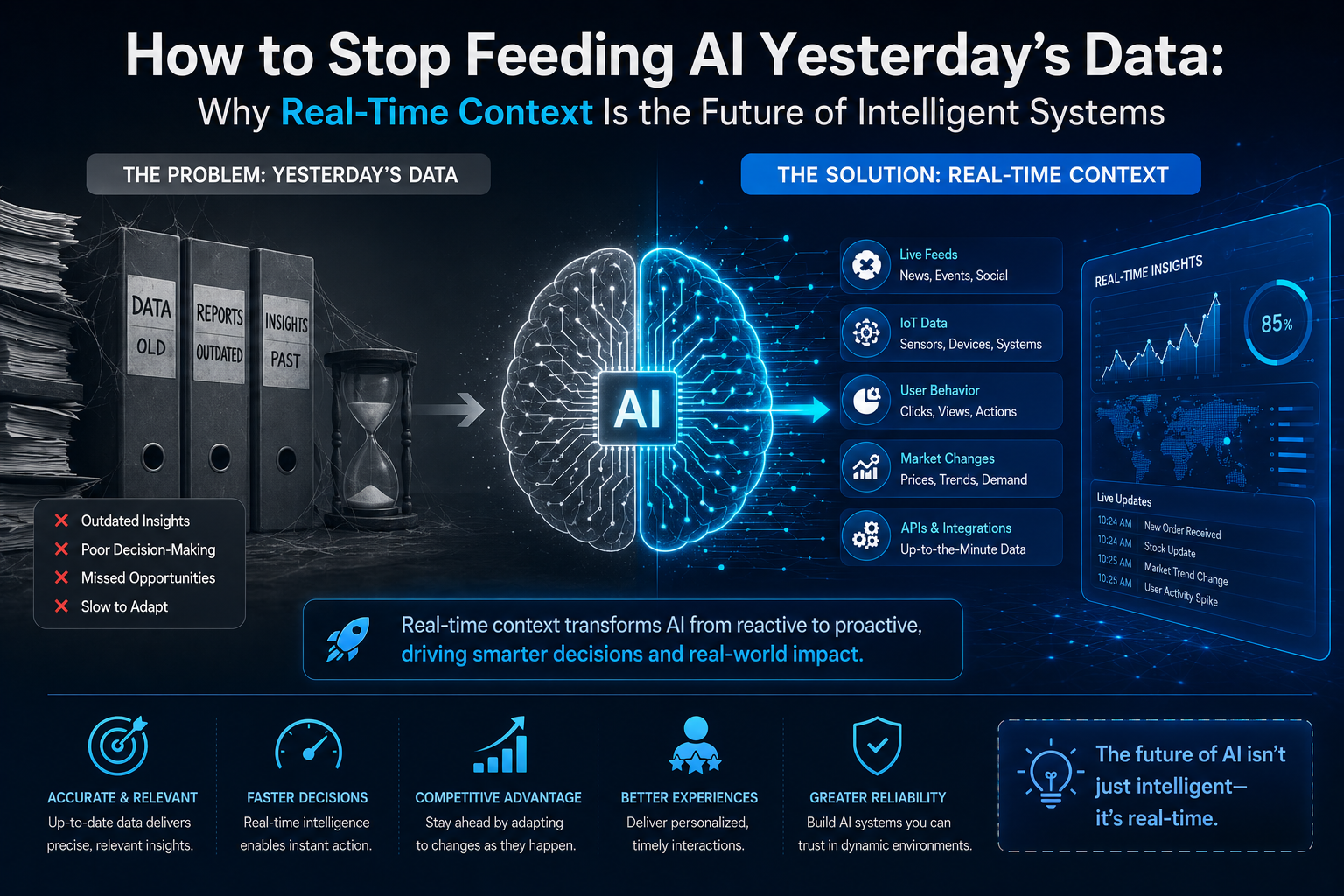
What Does “How to Stop Feeding AI Yesterday’s Data” Mean?
How to Stop Feeding AI Yesterday’s Data means replacing outdated information with real-time data streams so AI systems can make faster, more accurate decisions. Businesses achieve this using APIs, event-driven architecture, automation, and continuous data pipelines.
Why AI Needs Fresh Data
Artificial intelligence is transforming every industry, but many organizations still rely on outdated datasets. Even the most advanced AI model becomes less effective when it operates using yesterday’s information instead of live business events.
Whether it’s ecommerce, marketing, finance, or customer support, real-time context enables AI to produce better recommendations, faster decisions, and more accurate predictions.
The Hidden Cost of Stale Data
Outdated information can significantly reduce AI performance.
- Incorrect product recommendations
- Outdated inventory information
- Delayed customer support responses
- Inaccurate forecasting
- Poor marketing personalization
- Missed business opportunities
“An AI system is only as intelligent as the data it receives. Fresh data creates smarter decisions.”
Real-Time AI Changes Everything
Instead of waiting for scheduled database updates, modern AI platforms process events the moment they occur.
- Live inventory synchronization
- Real-time fraud detection
- Instant customer personalization
- Dynamic pricing updates
- Predictive analytics
- Business automation
Event-Driven Architecture
Event-driven architecture allows AI to react immediately whenever data changes.
Customer Activity
When a customer browses products or adds an item to their cart, AI instantly updates recommendations, promotions, and purchasing predictions.
Inventory Updates
If stock levels change, AI automatically updates product listings and suggests alternative products before customers encounter unavailable inventory.
Financial Transactions
Banks and payment systems use live AI to detect fraudulent activity within seconds rather than after scheduled processing.
AI Workflows Need Continuous Context
Today’s enterprise AI connects multiple systems together, including:
- CRM platforms
- Marketing automation
- Customer support software
- Inventory management
- Analytics dashboards
- Knowledge bases
- Business APIs
The more connected these systems become, the more valuable AI becomes.
How Ecommerce Benefits
Ecommerce businesses gain some of the greatest advantages from live AI.
- Personalized shopping experiences
- Real-time inventory visibility
- AI product recommendations
- Dynamic pricing
- Smarter customer service
- Higher conversion rates
Marketing Automation Gets Smarter
Marketing campaigns evolve constantly. Real-time AI monitors customer engagement, advertising performance, search behavior, and conversions to automatically optimize campaigns throughout the day.
Creator Economy Relies on Live Data
Content creators increasingly depend on AI to discover trends, schedule posts, optimize videos, analyze audiences, and automate content production using the latest information.
How to Build Smarter AI Systems
- Connect multiple business systems
- Automate data pipelines
- Monitor data quality continuously
- Use APIs for live synchronization
- Adopt event-driven architecture
- Scale AI alongside business growth
Common AI Data Mistakes
- Using spreadsheet imports
- Updating data once per day
- Disconnected business applications
- Poor API integration
- Ignoring live customer behavior
The Future of AI Is Real-Time
Modern AI is evolving beyond static machine learning. Future systems will continuously adapt to customer behavior, operational changes, and market conditions using live business intelligence.
Frequently Asked Questions
Why is outdated data bad for AI?
Outdated information causes AI to generate inaccurate predictions, poor recommendations, and slower business decisions.
What is real-time AI?
Real-time AI continuously receives live information so it can respond instantly to changing business events.
How do businesses provide AI with live data?
Organizations use APIs, automation platforms, cloud integrations, and event-driven systems that continuously synchronize information.
Which industries benefit most?
Ecommerce, finance, healthcare, logistics, manufacturing, cybersecurity, and digital marketing all benefit from real-time AI.
Conclusion
Understanding How to Stop Feeding AI Yesterday’s Data is becoming essential for organizations adopting artificial intelligence. Real-time information enables smarter automation, better customer experiences, and faster business decisions.
Businesses that embrace continuous data pipelines, event-driven architecture, and AI automation will gain a lasting competitive advantage in the rapidly evolving digital economy.


