
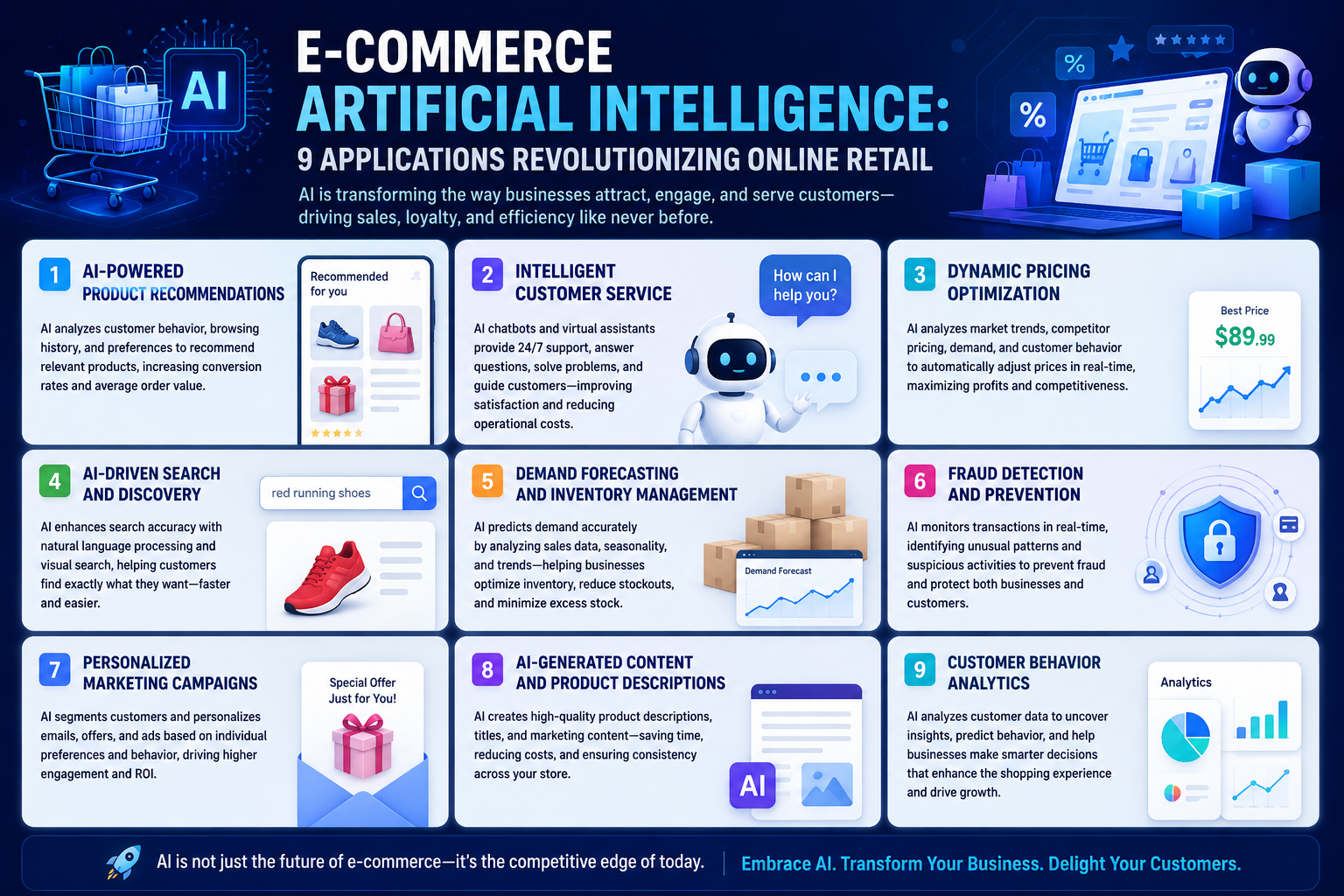
What is E-commerce Artificial Intelligence?
E-commerce Artificial Intelligence uses machine learning, automation, predictive analytics, and intelligent algorithms to improve online shopping experiences. Businesses use AI to personalize recommendations, automate customer support, optimize pricing, forecast inventory, and increase sales while reducing operational costs.
Why AI Is Transforming Ecommerce
Artificial intelligence has become one of the biggest innovations in digital commerce. Modern online stores generate enormous amounts of customer data every day, and AI converts this information into actionable insights that improve customer satisfaction and business performance.
Instead of relying on manual decisions, ecommerce businesses now use AI to automate repetitive tasks, understand customer behavior, predict future demand, and personalize every shopping experience.
- Personalized shopping experiences
- Higher conversion rates
- Reduced operating costs
- Smarter inventory management
- Improved customer service
- Better marketing performance
1. Personalized Product Recommendations
AI analyzes browsing history, purchase behavior, customer preferences, and shopping habits to recommend products that shoppers are most likely to purchase.
- Increase average order value
- Improve customer satisfaction
- Boost conversions
- Enhance product discovery
2. AI Customer Service Chatbots
Modern AI chatbots provide instant support around the clock by answering questions, recommending products, tracking orders, and assisting with returns.
This reduces customer waiting times while lowering support costs for online retailers.
3. Intelligent Product Search
Traditional keyword searches often fail to understand customer intent. AI-powered search engines recognize natural language, spelling mistakes, product context, and visual similarities to deliver more accurate search results.
4. Dynamic Pricing Optimization
AI continuously evaluates competitor pricing, demand, inventory levels, and market trends to automatically adjust product prices and maximize profitability.
- Real-time pricing updates
- Competitive pricing strategies
- Higher profit margins
- Improved sales performance
5. Inventory Forecasting
Machine learning predicts future demand using historical sales, seasonal patterns, promotional campaigns, and customer purchasing behavior.
Smarter inventory forecasting reduces stock shortages while minimizing excess inventory costs.
6. Fraud Detection and Payment Security
AI systems monitor payment activity and customer behavior in real time to detect suspicious transactions before fraud occurs.
- Transaction monitoring
- Behavior analysis
- Payment verification
- Risk assessment
7. Marketing Automation
Artificial intelligence improves digital marketing by automatically segmenting audiences, optimizing advertising campaigns, personalizing email marketing, and recommending products based on customer interests.
Businesses can deliver highly targeted campaigns while saving significant time.
8. Visual Search Technology
Visual AI allows shoppers to upload images instead of typing keywords. The AI identifies similar products available within an ecommerce catalog, making shopping faster and more intuitive.
9. Predictive Analytics
Predictive analytics uses AI to forecast future customer behavior, estimate lifetime value, predict churn, and identify buying intent before customers complete a purchase.
These insights help businesses make smarter strategic decisions that improve long-term growth.
Future of E-commerce Artificial Intelligence
The future of ecommerce will be increasingly powered by AI technologies including autonomous shopping assistants, generative AI product recommendations, voice commerce, and hyper-personalized customer experiences.
- Voice shopping
- AI shopping assistants
- Generative AI recommendations
- Autonomous purchasing
- Hyper-personalization
Conclusion
E-commerce Artificial Intelligence is revolutionizing online retail by helping businesses automate operations, personalize customer experiences, optimize pricing, improve inventory management, and make smarter business decisions. As AI technology continues evolving, companies that adopt intelligent ecommerce solutions today will be better positioned to compete, increase revenue, and deliver exceptional shopping experiences in the years ahead.


