
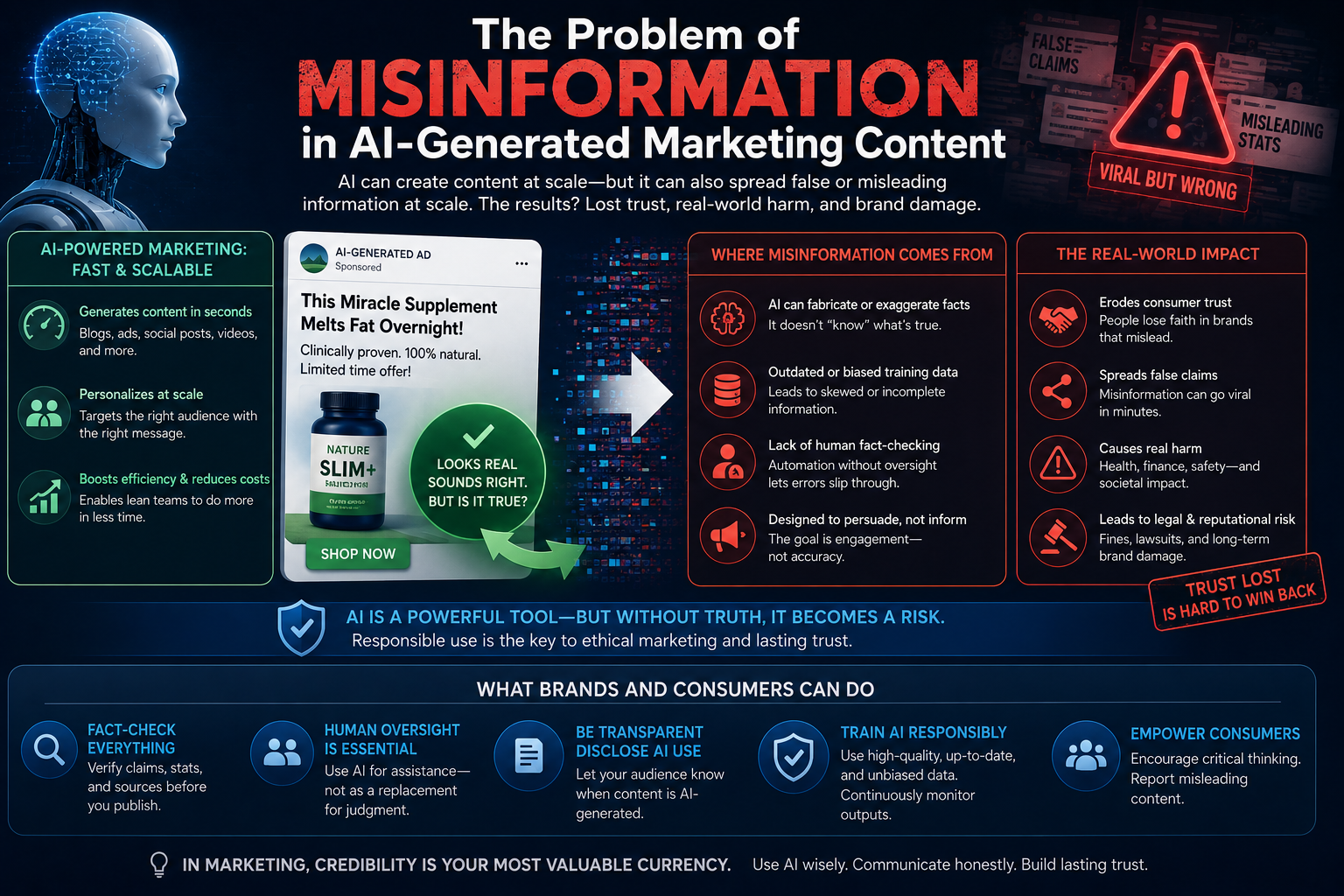
Featured Snippet
The Problem of Misinformation in AI-Generated Marketing Content refers to inaccurate, misleading, outdated, or fabricated information produced by AI systems and published as marketing material. While AI improves efficiency and scalability, businesses must implement verification processes to protect customer trust and brand reputation.
Why This Challenge Is Becoming Impossible to Ignore
The adoption of AI across marketing departments has accelerated rapidly. Businesses now use artificial intelligence to create blog posts, social media content, advertising copy, email campaigns, and product descriptions at unprecedented speed.
While automation offers major efficiency gains, it also introduces new risks. The most significant is misinformation—content that appears accurate but contains incorrect, outdated, or fabricated details.
As AI-generated media becomes a central part of digital marketing workflows, maintaining content accuracy is becoming a critical business priority.
How AI Creates Marketing Content
Modern AI systems generate content by identifying patterns within massive datasets and predicting likely text outputs.
These tools can help marketers:
- Create blog articles
- Generate advertising copy
- Write email campaigns
- Produce social media content
- Support SEO strategies
- Automate content workflows
However, AI does not verify information like a human expert. It predicts responses based on learned patterns, which can sometimes result in inaccurate content.
Understanding The Problem of Misinformation in AI-Generated Marketing Content
Not all misinformation is intentional. Many AI-generated inaccuracies appear convincing and professional, making them difficult to detect.
Fabricated Statistics
AI models may create numbers or data points that sound realistic but cannot be verified through reliable sources.
Outdated Information
Some AI-generated content may reference old industry trends, regulations, or market conditions that are no longer relevant.
Misinterpreted Context
AI can combine unrelated information and present it as a factual conclusion, creating confusion for readers.
Product Misrepresentation
Automated descriptions may exaggerate capabilities or present assumptions as facts.
The Growing Trust Crisis in Digital Marketing
Consumer trust is one of the most valuable assets any brand can build.
When AI-generated content contains misinformation, businesses risk damaging that trust through:
- Reduced credibility
- Customer dissatisfaction
- Negative online feedback
- Brand reputation damage
- Lower conversion rates
In today’s competitive digital landscape, trust often has a greater impact on long-term success than short-term marketing gains.
Why AI Content Scale Increases the Risk
Automation Multiplies Reach
A single inaccurate statement can quickly spread across multiple platforms through automated publishing systems.
- Blogs
- Social media channels
- Email campaigns
- Advertising platforms
- Video content workflows
This amplification makes misinformation more dangerous than traditional content errors.
Publishing Speed Reduces Review Time
Organizations focused on content volume may unintentionally reduce editorial oversight, allowing inaccuracies to reach audiences.
Business Risks of AI Marketing Misinformation
Brand Reputation Damage
Customers expect brands to provide accurate information. Repeated errors can weaken confidence and loyalty.
Compliance and Legal Issues
Industries such as finance, healthcare, and technology often face strict advertising regulations. Incorrect claims may create compliance challenges.
Reduced Marketing Performance
When audiences question content credibility, engagement, conversions, and customer retention can decline.
Search Visibility Challenges
Search engines increasingly prioritize trustworthy and authoritative content. Consistent inaccuracies can negatively impact long-term SEO performance.
Building Responsible AI Content Workflows
Maintain Human Oversight
AI should support human expertise rather than replace it. Editorial review remains essential for quality control.
Implement Verification Processes
- Fact-check key claims
- Verify statistics
- Review source accuracy
- Conduct compliance checks
- Approve content before publishing
Create AI Governance Policies
Organizations should establish clear guidelines regarding AI content generation, verification requirements, and editorial responsibilities.
The Future of AI Marketing Accuracy
Future AI systems are expected to include stronger fact-checking capabilities, real-time information access, and improved source attribution.
Despite these advances, human judgment will continue playing a critical role in ensuring content quality and protecting brand trust.
Best Practices for Preventing AI Content Misinformation
- Prioritize accuracy over publishing speed
- Verify all critical claims
- Train teams on AI limitations
- Use editorial approval workflows
- Maintain transparency with audiences
- Treat AI as a collaborator, not a replacement
Conclusion
The Problem of Misinformation in AI-Generated Marketing Content is becoming one of the defining challenges of the AI-powered marketing era.
While automation enables unprecedented efficiency, businesses must balance speed with accuracy. Brands that invest in verification systems, editorial oversight, and responsible AI governance will be better positioned to build trust, protect their reputation, and achieve sustainable growth.
As AI continues transforming digital marketing, success will depend not only on creating more content—but on creating content people can trust.


