
What Are the Risks of Using AI for YouTube Content Creation?
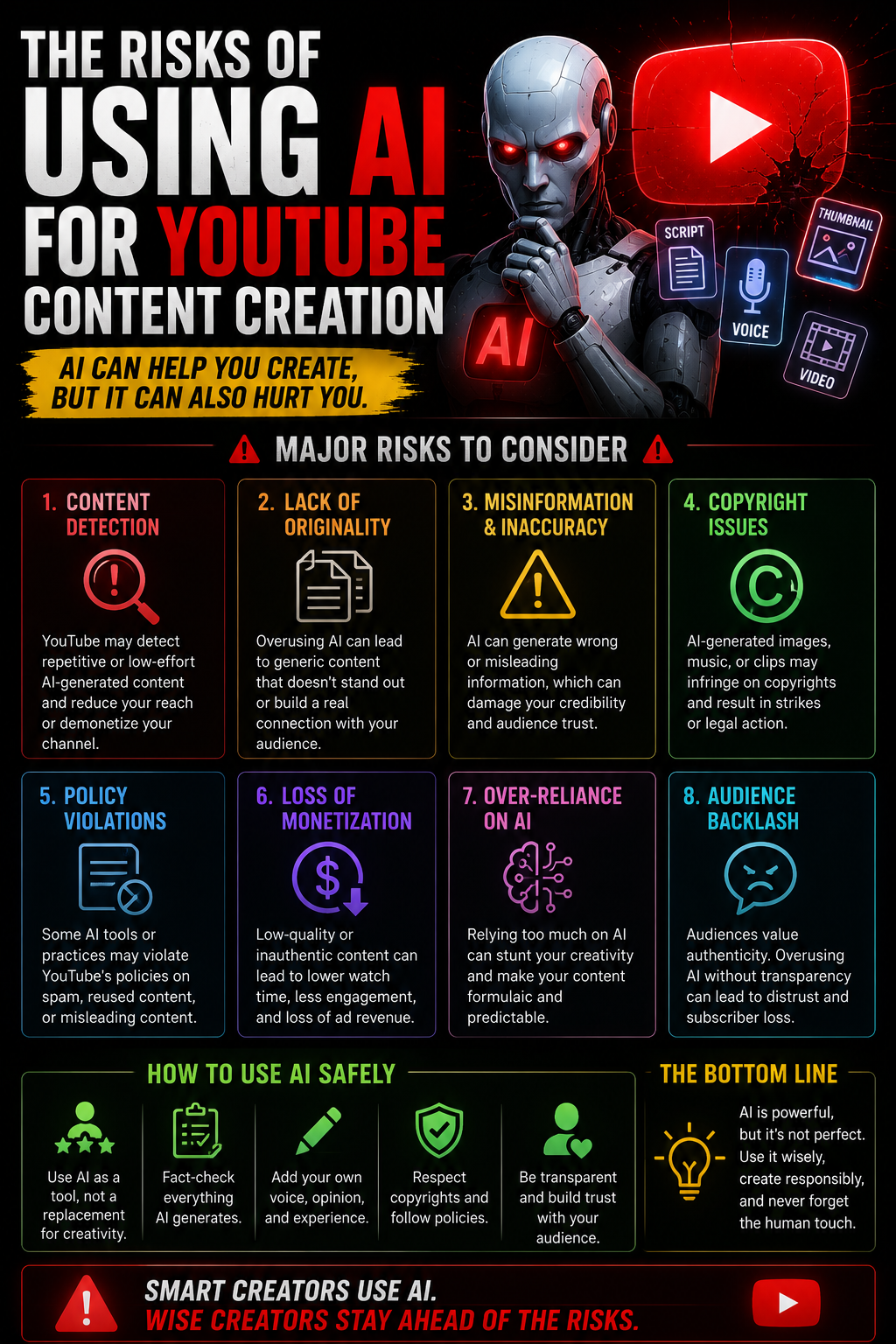
The Risks of Using AI for YouTube Content Creation include copyright concerns, reduced authenticity, misinformation, audience trust issues, monetization challenges, and increasing content saturation. While AI can streamline production, creators must balance automation with originality and quality.
Why AI Has Become Essential for YouTube Creators
Artificial intelligence is rapidly changing how creators produce videos. From automated script writing and voice generation to thumbnail design and video editing, AI-powered tools can dramatically reduce production time.
Many creators now rely on AI to scale content production, improve workflow efficiency, and compete in an increasingly crowded creator economy.
- AI script generation
- Voiceover automation
- Thumbnail creation
- Video editing assistance
- Audience analytics
- Content planning workflows
The Growing Authenticity Problem
One of the biggest concerns surrounding AI-generated content is authenticity. Audiences continue to value personality, expertise, and human storytelling.
Human Connection Still Matters
When creators rely heavily on AI-generated voices, repetitive scripts, and generic visuals, content can begin to feel impersonal.
Viewers increasingly recognize automated patterns, making it harder for channels to stand out and build loyal communities.
Copyright and Intellectual Property Risks
Among The Risks of Using AI for YouTube Content Creation, copyright concerns remain one of the most significant challenges.
Ownership Questions Continue to Evolve
AI systems generate content based on massive training datasets. This creates uncertainty regarding:
- Generated artwork ownership
- AI-created music rights
- Voice cloning permissions
- Training data disputes
- Licensing compliance
Creators should carefully review licensing terms before publishing AI-generated assets.
The Misinformation Challenge
AI tools can produce content quickly, but speed does not guarantee accuracy.
AI Can Generate Incorrect Information
Even advanced models occasionally create:
- Factual errors
- Outdated information
- Fabricated sources
- Misleading statements
For educational, business, and technology channels, publishing inaccurate information can damage credibility and viewer trust.
Monetization Challenges for AI-Generated Content
Many creators assume AI-generated videos automatically improve revenue opportunities. However, monetization depends heavily on originality and audience value.
Quality Remains the Priority
YouTube rewards content that provides unique experiences, meaningful engagement, and viewer satisfaction.
Low-effort automated content may struggle to maintain long-term monetization eligibility.
Oversaturation Is Increasing
Because AI lowers production barriers, more creators are publishing similar videos across every niche.
- Increased competition
- Reduced differentiation
- Content duplication
- Audience fatigue
Standing out now requires more than simply producing content faster.
Audience Trust and Transparency
Trust is becoming one of the most valuable assets in the AI-powered creator economy.
Transparency Builds Credibility
Many viewers appreciate AI-assisted workflows when creators remain transparent about their process.
Problems often arise when fully automated content is presented as entirely human-created.
- Reduced credibility
- Negative audience reactions
- Lower engagement rates
- Brand reputation concerns
The Impact on Creative Skills
Another overlooked risk involves creator skill development.
Over-Reliance on Automation
If AI handles every stage of content production, creators may lose opportunities to strengthen:
- Storytelling skills
- Research abilities
- Editing expertise
- Creative problem solving
- Brand voice development
The most successful creators use AI as a creative partner rather than a complete replacement.
Best Practices for Responsible AI Content Creation
Creators can minimize risks by implementing smart AI workflows.
- Maintain human oversight
- Fact-check generated content
- Verify licensing agreements
- Focus on originality
- Build a unique creator brand
- Use AI to enhance creativity, not replace it
The Future of AI and YouTube Content
AI will continue transforming content creation, video marketing, and creator economy workflows. However, future success will likely belong to creators who combine automation with genuine expertise, strategic branding, and authentic audience relationships.
Conclusion
The Risks of Using AI for YouTube Content Creation extend beyond simple automation concerns. Copyright challenges, authenticity issues, misinformation risks, monetization barriers, and audience trust all require careful consideration.
AI remains a powerful tool for creators, but sustainable growth comes from balancing efficiency with originality. Those who combine AI-powered workflows with human creativity will be best positioned for long-term success in the evolving creator economy.

What Are the Risks of Using AI for YouTube Content Creation?
The Risks of Using AI for YouTube Content Creation include copyright concerns, reduced authenticity, misinformation, audience trust issues, monetization challenges, and increasing content saturation. While AI can streamline production, creators must balance automation with originality and quality.
Why AI Has Become Essential for YouTube Creators
Artificial intelligence is rapidly changing how creators produce videos. From automated script writing and voice generation to thumbnail design and video editing, AI-powered tools can dramatically reduce production time.
Many creators now rely on AI to scale content production, improve workflow efficiency, and compete in an increasingly crowded creator economy.
- AI script generation
- Voiceover automation
- Thumbnail creation
- Video editing assistance
- Audience analytics
- Content planning workflows
The Growing Authenticity Problem
One of the biggest concerns surrounding AI-generated content is authenticity. Audiences continue to value personality, expertise, and human storytelling.
Human Connection Still Matters
When creators rely heavily on AI-generated voices, repetitive scripts, and generic visuals, content can begin to feel impersonal.
Viewers increasingly recognize automated patterns, making it harder for channels to stand out and build loyal communities.
Copyright and Intellectual Property Risks
Among The Risks of Using AI for YouTube Content Creation, copyright concerns remain one of the most significant challenges.
Ownership Questions Continue to Evolve
AI systems generate content based on massive training datasets. This creates uncertainty regarding:
- Generated artwork ownership
- AI-created music rights
- Voice cloning permissions
- Training data disputes
- Licensing compliance
Creators should carefully review licensing terms before publishing AI-generated assets.
The Misinformation Challenge
AI tools can produce content quickly, but speed does not guarantee accuracy.
AI Can Generate Incorrect Information
Even advanced models occasionally create:
- Factual errors
- Outdated information
- Fabricated sources
- Misleading statements
For educational, business, and technology channels, publishing inaccurate information can damage credibility and viewer trust.
Monetization Challenges for AI-Generated Content
Many creators assume AI-generated videos automatically improve revenue opportunities. However, monetization depends heavily on originality and audience value.
Quality Remains the Priority
YouTube rewards content that provides unique experiences, meaningful engagement, and viewer satisfaction.
Low-effort automated content may struggle to maintain long-term monetization eligibility.
Oversaturation Is Increasing
Because AI lowers production barriers, more creators are publishing similar videos across every niche.
- Increased competition
- Reduced differentiation
- Content duplication
- Audience fatigue
Standing out now requires more than simply producing content faster.
Audience Trust and Transparency
Trust is becoming one of the most valuable assets in the AI-powered creator economy.
Transparency Builds Credibility
Many viewers appreciate AI-assisted workflows when creators remain transparent about their process.
Problems often arise when fully automated content is presented as entirely human-created.
- Reduced credibility
- Negative audience reactions
- Lower engagement rates
- Brand reputation concerns
The Impact on Creative Skills
Another overlooked risk involves creator skill development.
Over-Reliance on Automation
If AI handles every stage of content production, creators may lose opportunities to strengthen:
- Storytelling skills
- Research abilities
- Editing expertise
- Creative problem solving
- Brand voice development
The most successful creators use AI as a creative partner rather than a complete replacement.
Best Practices for Responsible AI Content Creation
Creators can minimize risks by implementing smart AI workflows.
- Maintain human oversight
- Fact-check generated content
- Verify licensing agreements
- Focus on originality
- Build a unique creator brand
- Use AI to enhance creativity, not replace it
The Future of AI and YouTube Content
AI will continue transforming content creation, video marketing, and creator economy workflows. However, future success will likely belong to creators who combine automation with genuine expertise, strategic branding, and authentic audience relationships.
Conclusion
The Risks of Using AI for YouTube Content Creation extend beyond simple automation concerns. Copyright challenges, authenticity issues, misinformation risks, monetization barriers, and audience trust all require careful consideration.
AI remains a powerful tool for creators, but sustainable growth comes from balancing efficiency with originality. Those who combine AI-powered workflows with human creativity will be best positioned for long-term success in the evolving creator economy.


