
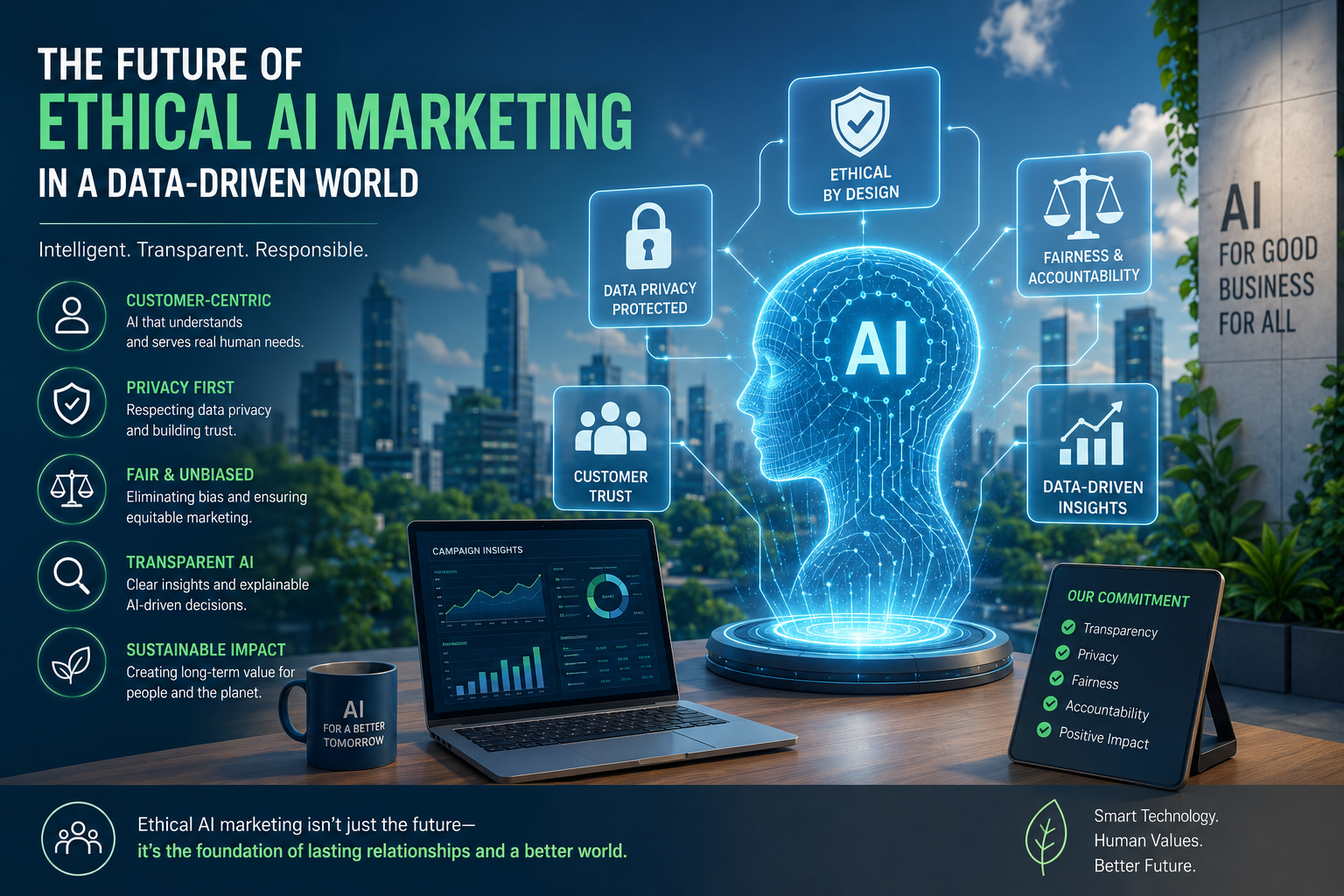
What Is The Future of Ethical AI Marketing in a Data-Driven World?
The Future of Ethical AI Marketing in a Data-Driven World centers on balancing powerful AI-driven personalization with consumer privacy, transparency, and trust. As businesses rely more on automation and customer data, ethical AI practices are becoming essential for maintaining credibility, compliance, and long-term growth.
A New Era of Marketing Is Emerging
The Future of Ethical AI Marketing in a Data-Driven World is rapidly becoming one of the most important discussions in business and technology.
Artificial intelligence has transformed how brands connect with audiences. From predictive analytics and automated content generation to personalized recommendations and customer segmentation, AI is reshaping every aspect of modern marketing.
However, as AI capabilities expand, so do concerns around privacy, transparency, and consumer trust.
The future belongs to organizations that can leverage intelligent automation while maintaining ethical standards and responsible data practices.
Why Ethical AI Marketing Matters More Than Ever
Modern marketing runs on data. Every interaction, click, purchase, and engagement generates valuable insights that AI systems use to optimize customer experiences.
While this creates tremendous opportunities, it also raises important questions:
- How much customer data should brands collect?
- Are AI recommendations unbiased?
- Do consumers understand how their information is used?
- Who is accountable when AI makes mistakes?
As AI becomes more powerful, ethical marketing practices are becoming critical for sustainable business success.
The Evolution of AI-Powered Marketing
From Automation to Intelligent Decision-Making
Marketing automation has evolved far beyond email scheduling and workflow management.
Today’s AI systems can:
- Predict customer behavior
- Generate marketing content
- Optimize advertising campaigns
- Analyze customer sentiment
- Personalize experiences in real time
- Improve conversion strategies
These technologies allow businesses to scale marketing efforts while delivering increasingly relevant customer experiences.
The Rise of Hyper-Personalization
AI-driven personalization has become one of the most valuable tools in modern marketing.
By analyzing user behavior, demographics, purchasing patterns, and engagement history, AI can create highly targeted campaigns that improve customer satisfaction and marketing performance.
However, excessive personalization can sometimes feel intrusive. Ethical AI marketing requires finding the balance between relevance and privacy.
Data Privacy Will Define the Future
Consumers Demand More Transparency
Today’s consumers are more informed than ever about how companies collect and use their data.
Customers increasingly want to know:
- What information is collected
- Why it is collected
- How it is stored
- Who can access it
- How long it remains in company databases
Brands that communicate these practices clearly are more likely to earn long-term trust.
Consent-Based Marketing Becomes Essential
Future marketing strategies will focus heavily on user consent and transparency.
Organizations are expected to adopt:
- Explicit permission-based data collection
- Clear privacy settings
- Simple opt-out mechanisms
- User-controlled personalization preferences
- Transparent data policies
These measures help create stronger relationships between brands and consumers.
Transparency as a Competitive Advantage
Explaining AI Decisions
Many AI systems function as complex algorithms that consumers rarely understand.
Ethical marketing requires brands to explain:
- Why advertisements appear
- How recommendations are generated
- What influences personalized experiences
- How customer data affects outcomes
Transparency builds confidence and reduces skepticism toward AI-driven marketing.
Disclosure of AI-Generated Content
As AI-generated content becomes increasingly common, consumers are demanding greater authenticity.
Future marketing campaigns may routinely disclose when content, images, videos, or advertisements have been generated or enhanced by AI systems.
This approach promotes trust while allowing brands to benefit from creative automation.
Addressing Algorithmic Bias
The Hidden Challenge of AI Bias
Artificial intelligence learns from historical data. If that data contains bias, marketing outcomes may unintentionally reinforce unfair patterns.
Potential risks include:
- Unequal audience targeting
- Discriminatory ad delivery
- Exclusion of demographic groups
- Biased recommendation systems
Responsible organizations continuously audit AI systems to identify and eliminate bias.
Why Human Oversight Still Matters
Despite advances in automation, human expertise remains essential.
Marketing professionals play a crucial role in:
- Reviewing AI-generated content
- Monitoring campaign outcomes
- Evaluating customer feedback
- Ensuring ethical compliance
- Protecting brand reputation
The most effective marketing strategies combine AI efficiency with human judgment.
AI Content Creation and Ethical Media Production
AI-powered creative tools are transforming content production across industries.
Brands now use AI to generate:
- Blog articles
- Video scripts
- Social media content
- Visual assets
- Advertising copy
- Creative concepts
The challenge is maintaining authenticity while scaling content creation.
Successful organizations build ethical content workflows that include human review, fact-checking, brand compliance, and transparency measures.
The Impact on the Creator Economy
The creator economy is rapidly embracing AI tools to improve productivity and audience engagement.
Creators use AI for:
- Content planning
- Video production
- Audience analytics
- Marketing automation
- Creative ideation
However, audiences increasingly expect transparency regarding AI-generated media, sponsored content, and automated interactions.
Creators who communicate openly about their use of AI are more likely to build loyal and engaged communities.
Business Benefits of Ethical AI Marketing
Ethical AI is not only a compliance requirement—it is a growth strategy.
- Stronger Customer Trust
- Improved Brand Reputation
- Higher Customer Retention
- Reduced Regulatory Risk
- Sustainable Competitive Advantage
Organizations that prioritize ethics often create deeper customer relationships and long-term business value.
What the Future Holds
Several trends are expected to shape the next phase of AI marketing:
- Expanded AI regulations
- Greater transparency requirements
- Privacy-first marketing strategies
- Dedicated AI governance programs
- Increased human-AI collaboration
The future of marketing is not about replacing humans. It is about creating smarter partnerships between technology and people.
How Brands Can Prepare Today
- Audit existing AI systems
- Improve data transparency
- Create ethical AI guidelines
- Monitor algorithms for bias
- Maintain human oversight
- Prioritize customer privacy
- Educate teams on responsible AI use
- Build trust-focused marketing strategies
Conclusion
The Future of Ethical AI Marketing in a Data-Driven World will be defined by transparency, accountability, and consumer trust.
As artificial intelligence becomes increasingly integrated into marketing workflows, businesses must balance innovation with responsibility.
The brands that succeed will be those that use AI not only to improve performance but also to strengthen customer relationships and build lasting trust.
Ethical AI marketing represents the next evolution of digital business strategy—where technology, creativity, and integrity work together to drive sustainable growth.


